How can I use my interview skills to gather ideas and information, write an interesting biography for a classmate and present it to the class?
- What is a biography? What should I include in one?
- I identify nonfiction and describe the key characteristics of biographies. 2.3.1
- How do I conduct an effective interview?
- I contribute collaboratively in group situations, by asking questions and building on the ideas of others 5.2.1
- How do I organize my writing?
- I organize ideas and information by selecting categories for my research and writing.
- I develop questions that will help me develop ideas for my writing.
- I select information that will help the class get to know a classmate. 3.3.1
- What will make it interesting?
- I identify and use a hook, story examples and vivid vocabulary to get and keep my audience’s attention. 4.3.3
- I use my personal understandings to show something important about my peer. I use background knowledge, things I’ve read before and life experience to help me. 1.1.2
- How do I link ideas from one paragraph to another?
- I write paragraphs with well-developed and well-linked ideas and sections 3.3.2
- How do I present my ideas to the class?
- I use concept mapping and mental rehearsal to remember main ideas and relevant details 2.1.4
PREWRITING: Understanding basic paragraph structure
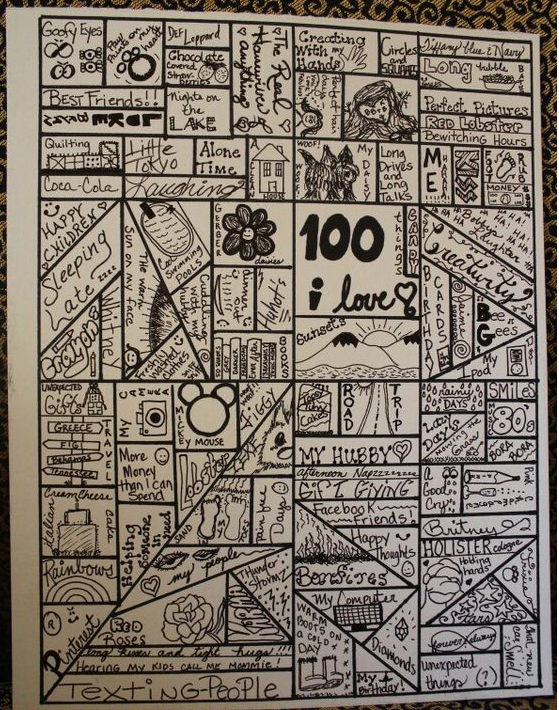
Students first review paragraph structure by completing "100 Things I love" posters and writing a paragraph.
100 Things I love
This is a fun activity to see how well you can brainstorm and find out a little about yourself at the same time. It’s simple. Write the title somewhere on the page and make a list. If you want to use the geometric shapes page to record your ideas you can but you don’t have to. 100 things can seem like a lot until you reeeeeaaaaaly think. Sometimes it helps to think about categories first. What categories do you see in the example? We’ll use these lists to help us find ideas to write about.
https://www.pinterest.co.uk/pin/264375440598463358/
We identifyied our top 2 ideas that we knew have a story attached to them and told a peer about our experience. Then we wrote a paragraph.
Students checked the paragraph for Organizaiton by examining the criteria below:

https://sites.google.com/gshare.blackgold.ca/sharedresources/grade-seven?authuser=0
Students will set writing goals and recieve feedback from Mrs A using the following Form:
Students will set writing goals and recieve feedback from Mrs A using the following Form:
100 Things Paragraph Rubric Name: Class:
Outcomes
|
Excellent
|
Proficient
|
Satisfactory
|
Limited
|
I revise introductions, conclusions and the order of ideas and information to add coherence and clarify meaning. 4.1.3
|
My topic sentence and concluding sentence are interesting and well written and include the main idea using synonym phrases.
The order of ideas is clear because of well used transitions and the ideas flow naturally from one to the next.
|
My topic sentence and concluding sentence are logically written and include the main idea.
The order of ideas is clear because of transitions and the ideas flow logically from one to the next.
|
My topic sentence and concluding sentence are present and include the main idea.
The order of ideas is somewhat clear because transitions are used sometimes and the ideas sometimes flow from one to the next.
|
My topic sentence and concluding sentence are present but are missing a main idea.
The order of ideas is confusing because transitions are missing or used incorrectly. The ideas do not flow from one to the next.
|
TEACHER FEEDBACK using RADaR: A ✔ item should be applied to your paragraph:
And…
| ||||
STUDENT REFLECTION:
One question I have is…
A few things I’ll work on for my piece of writing are…
| ||||
What is a biography? What should I include in one?
Students read and excerpt from "I am Malala" and identify how the author engages the audience.
- I identify nonfiction and describe the key characteristics of biographies. 2.3.1
Might include:
- Imagery - Use language that appeals to the 5 senses (creates a picture, puts us there)
- Foreshadowing - hint at something in the future
- Question - use questions about life or the future
- Figurative language - SHAMPOO to describe - creates imagery
- Voice - have personality in writing; use words that sound like you. For example: "she was the friend of my heart"
What are the Characteristics of a Biography?

You will need a highlighter, a pencil and a keen eye to find all the items on the list!
Read the text on your own then complete the tasks below:
- Find and label the HOOK - this should be a sentence that stands apart from the rest of the text or is the first sentence in the first paragraph. Note why it’s interesting. (use our notes)
- Find and label 5 examples of information that is based on fact. (truth)
- Find and label one of each:
- Incident
- Quote from the person being profiled
- Highlight and label a part that you can relate to. Explain how you relate. (This means you understand them - their emotions, experiences or ideas)
- Highlight and label 2 techniques in the writing that grab your attention. (use your notes)
- STAR and label structural features that help organize: title, pictures, shapes, headings, charts, bold words, maps, diagrams.
- Underline the main idea for the first 3 paragraphs.
- On the back of the Biography write a brief summary explaining who the person is and what makes this person noteworthy, or someone you should remember or admire. (Use Who, what, where, when, why how)
Once you are finished, number yourselves: 1, 2, 3, 4. (write the number at the top of your page) THEN be prepared to share what you have found with another group.
Share your opinion about these things:
- Do you like the visual layout of this biography? Why? Or Why not? What would you change or keep about it?
- What are the best writing techniques used to grab attention? Share an example.
- What big topics come up in the biography? Are these the same for the other biographies? For example: The person’s background - where they grew up or family life.
- How is your biography different from the others? Do these differences make the biography more or less effective? Why?
What are the characteristics of a Biography? Make a list with your group. Be prepared to share this list with the Whole class.


