Friday, 2 September 2016

Starting our Writer's Notebooks

Writer's Notebooks


What is a writer's notebook?  Why should I start one?
  • it's a safe place to generate ideas and select a writing topic
  • it's a starting point for writing 
  • it contains lists, images, maps, quotes, poems observations about writing
  • it allows me relief from a grade
  • one out of everly four entries will be developed further and eventually published for a grade
Students began their first entry today.  See image below:


We'll share what our brainstorming means with others through pair sharing and then free writing.

Please bring a duotang to class for your writer's notebook.  

Make sure your brainstorming page has 5-7 ideas and a splash of colour. Due Wednesday September 7 for 9ACG.

Setting up our Writer's Notebook

To keep ourselves organized we put our name class and titled our Wrtiers Notebooks:


Created an index:

Recorded "Free Writing Rules":


Thursday, 1 September 2016

Grade 8 & 9 Welcome Back!

Welcome Back!


9C please return your school forms as soon as possible.  I know there are a lot but that means there are more to lose if you wait too long to get them all signed by Mom or Dad. : )


We are currently going through the LA 9 course outline.  See the introduction below:


Friday, Sep 2 - Students brainstormed what makes an ideal learning environment using think pair share strategy.  We generated a list of criteria and we will complete a whole class list on Tuesday, September 6.


Students completed a card sort activity today and will finish it tomorrow.  From this activity we'll establish our three main Class Expectations that are at the foundation of an ideal learning environment.

Our categories will be:

  • Teacher's responsibilities 
  • Students' responsibilities
  • Attitudes 

Thursday, 28 April 2016

Grade 8: The Giver

Grade 8: "The Giver," by Lois Lowery

Focus Question:  How important is it for people to have choices in their lives?

Before reading the novel, students viewed a variety of images to record what they think they know about Utopias and Dystopias.

Then they watched two videos which featured utopias:

Students recorded what they saw and then explained why the item made the utopia an ideal world for the occupants.

We formed a definition based on this info:

            • Utopia: A place, state, or condition that is ideally perfect in respect of politics, laws, customs, and conditions.


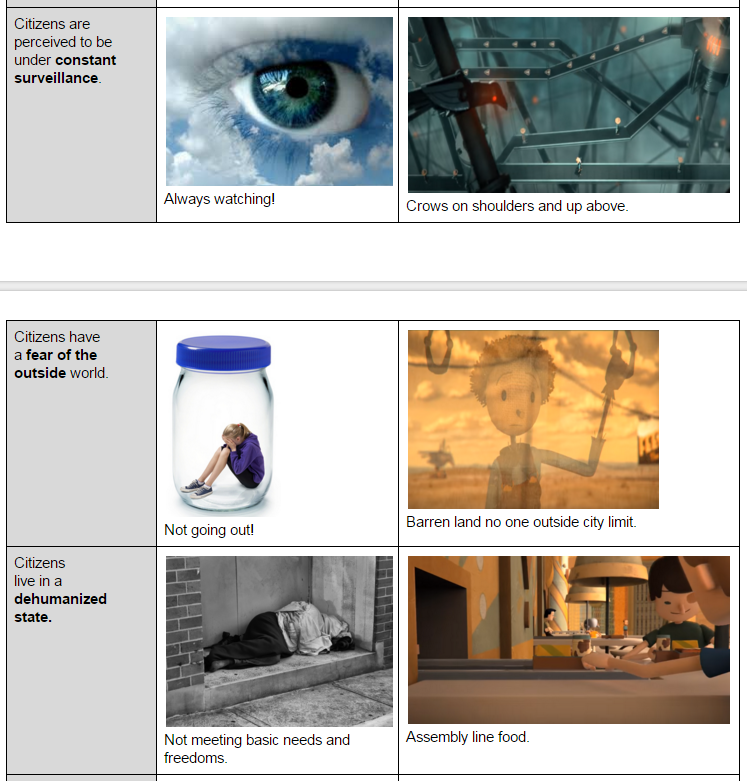
Next, we watched The Scarecrow and recorded what we saw and formed some questions about what we WANT to know:


We realized that there were many more characteristics found in a Dystopia that we were missing so we completed the chart below:


Students shared their ideas and used these ideas as a starting point:


Next we read "The Lottery" to try to answer our WANT to KNOW Questions.

We read "The Pedestrian," by Ray Bradbury and answered the questions below:

  1. How would you describe the atmosphere established in the opening paragraphs of the story?
  2. what does Mead's "brightly lit" house tell us about him?  What evidence in the story as a whole supports this view?
  3. The author describes mead's walk as being "...not unequal to walking through a graveyard..." In what ways is the city like a graveyard?
  4. How would you describe life in this city in the year 2053?  Consider the story carefully and identify specific examples of Bradbury's use of language that have enabled you to reach you r conclusion.
  5. The voice from the police-car notes: "no profession" in response to the pedestrian's statement that he is a writer.  What does this particular utterance reveal about the society in which the story is set?
  6. When did you realize that there was no-one driving the police car?  Why is it that the identity of the voice in the car is kept anonymous?  Who do you think is actually "controlling" the car?
  7. Why is Mead arrested?  What is his punishment to be? Why?  How is the repetition of the word "empty" particularly ominous at the end of the story?
We are discussing our ideas using a carousel.  Each group records their best discussion points and evidence from the text.  When groups move back to their starting point they reread all the responses and decide on three Key ideas worth sharing out to the whole class.


"The Giver": How important are choices?

We have begun to read "The Giver," by Lois Lowry.

Students are completing Readers Responses as starting points for discussion.

After each chunk of reading students will form small discussion groups and complete a small discussion task.

These discussion tasks will help them complete a persuasive zine (mini magazine)

Students will write a persuasive essay to compliment their zine.


See READERS RESPONSE activities below:


Monday, 11 April 2016

Grade 9: "A Monster Calls," by Patrick Ness

"A Monster Calls," by Patrick Ness

Focus Questions:
What monsters haunt us?  What might we learn from characters in stories to  help us deal with our personal monsters?


Before Reading the novel, students needed to know what a Yew Tree is so we read 2 articles to find out. See Below:

Students examined the two opposing points of view using a tug of war thinking strategy. We read each article and identified 3 tugs that make the following claim true and false.

CLAIM: Natural remedies are better for people than scientifically engineered ones.


Next, we answered a few questions about monsters using Lynda Barry's "What it is".  See image below:


We thought:

There were so many monsters in old stories because...
  • we believed in them
  • they were used as warnings and teachings
  • they are entertaining

We need monsters because...
  • they give us a tangible way to cope with fears or problems

TRUE, where ever there are people, you will find stories of monsters...
  • Different times call for different monsters: cold war - alien invasion stories, currently zombies - global warming or biological warfare fears

Next, we watched the book trailer and movie trailer to make a prediction about why this monster is in the protagonist's life.

Students thought... 
  • From the book trailer: "the monster wants the truth" means the monster was there to help Conor face something (book trailer observation)
  • From the movie trailer: "The invisible man calls for a monster" meant that Conor needs the monster to be seen again.

While we read the novel, we will be actively reading the exposition of the novel by recording our observations about when and where the monster shows up.  See below:

What is characterization?  Why does the author rely so heavily on indirect characterization?


Students have been recording their brief observations about the character's personalities using the chart below:


This information will help us create Want Ads for one of the characters in the exposition.  We will focus on one character and one situation they find themselves in.  Then identify what they seem to need based on an excerpt from the novel.

I statement: I experiment with language and components found in a want ad to show my understanding of a character's perspective.

To deepen students understanding of character's perspective we watched Disney's "Feast" and answered the following questions?

What is perspective?  How does Winston see the world?  How does the man? The woman?


Next, we identified what Winston might need or want in his situation and we created a want ad as a whole class:


We read "Grandma" together and identified her situation and what she might need or want to help her.  We want to be sure we show an understanding of her perspective.

See our brainstorming below:


Next, students identified different styles of want Ads and common features found in all of them.  As a class we construct a quick Want Ad for Grandma based on our observations.  We included: 
  • Clear Headline 
  • Interesting Hook 
  • Words that improve authenticity 
  • Purposeful Font size and shape  
  • Informative Image 


Example:


Students generated a list of the character's needs:
  • truth
  • friendship
  • compassion
  • strength
  • courage
  • appreciation
  • kindness
Based on this list we all did some free writing see Mrs. Anderson's example below:


When we were finished we watched a TEDEd video, "The Case against GOOD and BAD" and answered the following questions:

Why does the woman dislike "GOOD" and "BAD"?
                                           &
How can I use this information?

We used stars and stairs feedback strategy to think about our writing and share phrases we felt were particularly beautiful.

The next three chapters of the book we'll focus on passages we feel are particularly beautifully written and imitate some of these moves in our own writing.


Students Watched Boyd Varty's TedTalk to think about:
  • What is a memoir?
  • What makes a memoir interesting?

See some of our observations and ideas below:


We read "On Love and a Lake," by Renee David to identify lessons in the writing and note a star and stair based on our definition.


Students pulled out events with vivid details and lessons learned using the chart below:


Students used their free writing to mine for a story that would show the importance of overcoming an obstacle in their lives.  

After identifying an obstacle we used telling boards to expand on our big moments in our memories.  See example below:


Steps to using a Telling Board:

  1. Sketch big moments & Caption what's happening
  2. Use criteria to make improvements (show your reader your experience by including vivid sensory details)
  3. ADD DETAILS - labels, speech bubbles, narrator box
  4. Tell your story & Listen to your peer's Stars and Stairs 
  5. FIX your story: ADD Lessons include the KEY WORDS(important to overcome obstacles)
  6. Tell again and type.
  7. SELF-assess with rubric


BACK TO THE BOOK...


Now that we're finished the Provincial Achievement Test, we are continuing to read "A Monster Calls".  Students are focusing on the understanding the main character, Conor.

We are using a CSI strategy to think about Conor's character.  See exemplar below:


Students discuss ideas that are important, interesting, insightful from a chunk of reading and then use a colour, symbol, and image to represent their understanding of Conor's character.  

See our class example below:

We realized it was important to explain our choice and to prove why it was a good choice by pulling out evidence from the text.

We are analyzing the "tales" the monster tells Conor by completing an Analogy Organizer. See our first analysis below:


Monday, 21 March 2016

Grade 8 Conformity vs. Individuality

Conformity vs. Individuality
Focus Questions: 
  • How have nonconformists contributed to society?  
  • How can I use my discussion and research skills to help others understand my point of view?
Students watched a YouTube video to form their own definition of conformity.
Changing what you usually do to follow or copy the majority because of pressure to fit in or because of influence.

Next, we read the poem "Identity," by Julio Noboa Polanco to understand what motivates a nonconformist.


After analyzing the poem we read three texts from "Sightlines" that featured:
  • Nelson Mandela
  • Nellie McClung
  • Raoul Wallenberg
Students highlighted 3 things that made the person a successful nonconformist.  Students annotated their highlighting by explaining why they needed the item or by jotting down a trait the item demonstrated.  

Mrs. Anderson modeled how to annotate their texts.


Students listed between 5-7 items and ranked them from most important to least important.  Then they created a recipe and a tagul to present to the class as a means to discuss what makes a nonconformist.


See the instruction sheet below for creating a tagul.  This document is in Google Classroom.


Students helped Mrs. Anderson create a rubric for presenting our Recipes and Taguls to the class.


Students presented their ideas to the class on Monday, March 21.  We discovered our ideas are not as thorough when we present them than when we write about them.

Students set goals for improving CONTENT of presentations.  Some ideas are:
  • Explain by using several examples form the story and own life
  • Using several different sources to find more examples
  • Thinking and explaining ideas by asking others and noting many ideas
Students set goals for improving ORGANIZATION of presentations.  Some ideas are:
  • Introduce in a general way
  • Use images as a way to transition from one idea to the next
  • Explain big ideas and then examples 
  • Sum up with an overall statement about the main idea
See some of our great work below:


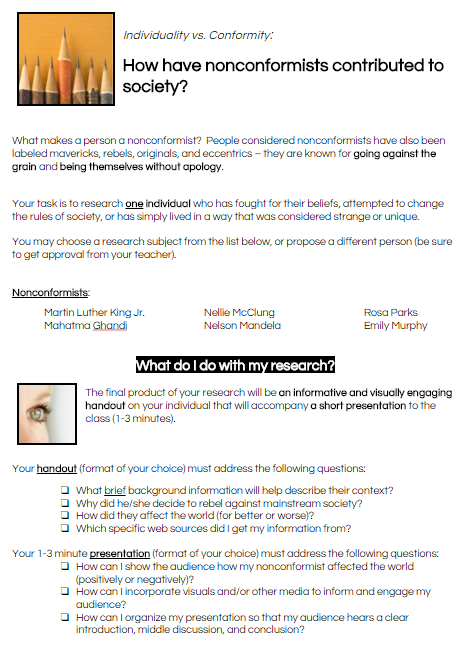
Nonconformist Research Project:

Students watched a PowToon video and answered: What is the research process?

  • They noted that some of the stages of the process we were not going to complete this year but will next year.
Six Stages:  Explore, Identify, Gather, Create, Share, Reflect.

We noted what we have done so far:

  • Explored 
- definition of conformity and individuality
- created a recipe to identify traits and motivations of nonconformists
- examined 4 nonconformist from history: Nellie McClung, Nelson Mandella, Raoul Wallenberg, and Andy Warhol


  • Identified Questions to answer
- using the project handout (see below)


  • Gather through Research 
- As a class we set criteria for Website Credibility:

- We have reviewed structural features to help locate information quickly
- We discussed how to summarize and paraphrase info from a site (using a graphic organizer)

- We are assessing how much info we need to give a thorough informative product


  • Create - identify a list of products 


LA 7 Fantastic Fiction: Flashback and "Knife"

Fantastic Fiction What are the elements of fiction? How do I identify conflict and explain how it is developed and resolved? ...